






Free Vedic stone finder
Which stones are best for me?
Enter your birth date. We read your Vedic moon sign and match stones to it, with every reason explained.
You
Invalid
Your moon sign (rashi) comes from where the moon was on this day.
Invalid
Time and city let us read your rising sign (lagna) too, for picks closer to you.
We use your rashi, the moon sign in your kundli. It often differs from the Western sun sign.
Reading your chart
Western sun sign ·
Why two signs?
Kundli match · Guna Milan
Read the Vedic way from both moon positions, without gender. Where tradition reads one way only, we take the kinder reading.
Want to go deeper?
Tara, our astro consultant, starts from these picks and your details. Your details are ready in the chat. You choose whether to send them.
Questions
- Your signs. We work out your moon sign (rashi) and, with your birth time and city, your rising sign (lagna). Both use the Vedic zodiac, the one in an Indian kundli.
- Your guiding planet. This is the ruler of your rising sign, or of your moon sign if we don't have your time and city. In Vedic tradition the ruler of the rising sign is the safest planet to strengthen.
- Its stone. We use a classical Vedic gem or a recognised Vedic substitute that we make, and never pair stones that tradition says clash. For Saturn we suggest amethyst, not blue sapphire, which tradition says needs a full chart reading.
- Your goal. We add a stone for what you asked for. Many of these come from modern crystal practice rather than Vedic texts, and every stone is labelled so you can see which is which.
- Tara goes deeper. These picks follow tradition and belief, not a promise of any result. Tara can read your details and build on them.
- Classical Vedic gem
- Vedic Uparatna stone
- Sacred bead
- Indian folk tradition
- Modern crystal practice
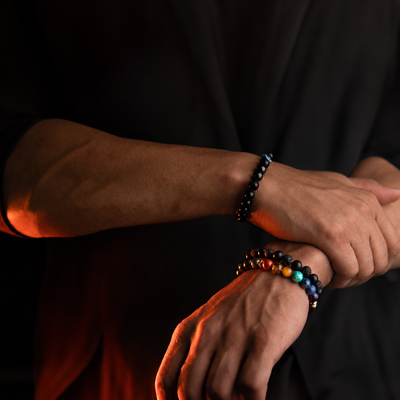
Wear it on whichever wrist feels comfortable. In tradition, the left hand is seen as the receiving side and the right as the giving side, so many people wear a stone bracelet on the left. Choose the side that feels right to you.
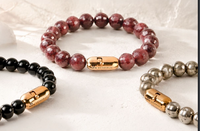
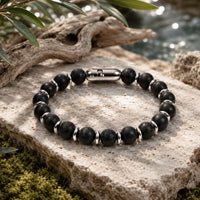
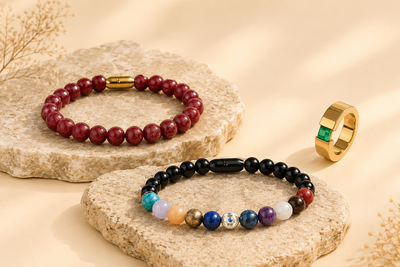
Yes, we use natural stones, and every bracelet comes with an authenticity certificate card. We don't put a letter grade on our stones. One finish is coated: the gold hematite square has a metallic gold coating over natural hematite. Each stone's details, including where that stone is found, are on its product page.
Your rashi is the sign the moon was in when you were born, read the Vedic way against the fixed stars. It is the sign in your kundli. Western horoscopes use the sun sign instead, so your rashi is often a different sign from the one you read in a horoscope.
In Vedic astrology each of the nine planets has one classical gem, called a Navaratna: natural ruby for the Sun, pearl for the Moon, emerald for Mercury, and so on. Tradition also names gentler stones for the same planets, called uparatna (upa means secondary, ratna means gem). They are linked with the same planet, are seen as milder, and cost far less, so they are the usual everyday choice. On this page every stone has a label that says where its link comes from: classical Vedic gem, Vedic Uparatna stone, sacred, folk, or modern crystal practice.
It helps. The moon changes sign every two to three days, so on some dates your rashi depends on the hour. If you leave the time out and the moon changed sign that day, the page shows both signs and when it changed. We read the time as India time, so if you were born outside India, ask Tara.
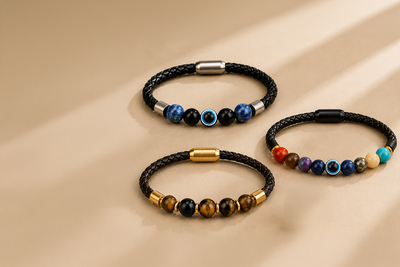
The 12 sign bracelets come as shown. To change a stone, design your own in our custom bracelet builder: pick each stone bead by bead, add a centre charm and your initials, and choose a MagSnap 4 or elastic closure. Builder bracelets are made to order, paid online, and can't be exchanged for size, so check your wrist size first.
Which stone is best for me? The rashi stone chart
In Vedic astrology, your rashi is the sign the moon was in when you were born. Each rashi has a ruling planet, and each planet has a classical gem from the Navaratna, the nine gems. Gentler stones, called uparatna, are traditionally linked with the same planets. Find your rashi below, or use the finder above for an answer from your birth date and time.
| Rashi (moon sign) | Ruling planet | Classical gem | Stones in our bracelets |
|---|---|---|---|
| Mesh (Aries) | Mars (Mangal) | Red coral (Moonga) | Carnelian |
| Vrishabh (Taurus) | Venus (Shukra) | Diamond (Heera) | Clear quartz |
| Mithun (Gemini) | Mercury (Budh) | Emerald (Panna) | Jade, emerald, peridot |
| Kark (Cancer) | Moon (Chandra) | Pearl (Moti) | Moonstone, pearl, white coral |
| Simha (Leo) | Sun (Surya) | Natural ruby (Manik) | Garnet, natural ruby, pink tourmaline |
| Kanya (Virgo) | Mercury (Budh) | Emerald (Panna) | Jade, emerald, peridot |
| Tula (Libra) | Venus (Shukra) | Diamond (Heera) | Clear quartz |
| Vrishchik (Scorpio) | Mars (Mangal) | Red coral (Moonga) | Carnelian |
| Dhanu (Sagittarius) | Jupiter (Guru) | Yellow sapphire (Pukhraj) | Citrine |
| Makar (Capricorn) | Saturn (Shani) | Blue sapphire (Neelam) | Amethyst, lapis lazuli |
| Kumbh (Aquarius) | Saturn (Shani) | Blue sapphire (Neelam) | Amethyst, lapis lazuli |
| Meen (Pisces) | Jupiter (Guru) | Yellow sapphire (Pukhraj) | Citrine |
Blue sapphire (Neelam) is the classical gem for Saturn, and tradition treats it with caution, so the finder never picks it for you. It suggests amethyst, a gentler stone for Saturn, and Tara can talk you through the rest.
How the stone finder works
The finder works out your moon sign the Vedic way, against the fixed stars (the sidereal zodiac with the Lahiri ayanamsa, the system most Indian panchangs use). With your birth time and city it also finds your rising sign (lagna) and your birth star (nakshatra). The ruling planet of your rising sign, or of your moon sign if you skip the time, becomes your guiding planet. Its stones, and the goal you pick, decide the three picks: a custom bracelet, the closest ready design and your sign's zodiac bracelet. Every stone carries a label that says where its link comes from: classical gem, Vedic substitute, sacred, folk or modern.
Kundli matching for couples: how Guna Milan is scored
Guna Milan, also called Ashtakoota matching, compares two moon signs and birth stars across eight kootas, worth 36 points in all. Switch the finder to couple mode, enter both birth dates, and it shows your score, each koota's points and a stone pick for each of you.
| Koota | What it looks at | Points |
|---|---|---|
| Varna | Values and outlook | 1 |
| Vashya | Mutual pull | 2 |
| Tara | Wellbeing together | 3 |
| Yoni | Physical comfort | 4 |
| Graha Maitri | Friendship of minds | 5 |
| Gana | Temperament | 6 |
| Bhakoot | Love and family growth | 7 |
| Nadi | Health and family | 8 |
| Total | 36 |
By tradition, 18 points or more is a good match, 25 or more is very good and 33 or more is excellent. A score is one traditional view, not a verdict on a relationship.
Rashi, lagna, nakshatra: the words, explained
- Rashi (moon sign)
- The sign the moon was in when you were born, read against the fixed stars. It is the sign most Indian horoscopes use.
- Sun sign
- The sign the sun was in, used by Western horoscopes. It is often a different sign from your rashi.
- Lagna (rising sign)
- The sign rising on the eastern horizon at your birth time and place. It needs your birth time and city.
- Nakshatra (birth star)
- One of 27 star groups the moon passes through. Your birth star is the one the moon was in when you were born.
- Kundli
- Your Vedic birth chart: where the sun, moon and planets were at your birth, set out in twelve houses.
- Guna Milan
- The traditional kundli matching score for a couple, out of 36 points across eight kootas.
- Navaratna
- The nine classical gems of Vedic astrology, one for each of the nine planets.
- Uparatna (Vedic Uparatna stone)
- Upa means secondary and ratna means gem: the gentler stones Vedic tradition names for the same planets as the nine classical gems, worn more freely and costing far less.
Birth-city list includes data from the Countries States Cities Database, made available under the Open Database License (ODbL 1.0).
Made just for you
Your bracelet is strung by hand to the exact design you pick, only after you order. So two things work differently.
- Prepaid only. Cash on Delivery isn't available on any order with a custom bracelet in it.
- No size exchanges. It's made to your wrist size, so check the size guide first.
- Still covered. Your 6-month warranty applies as usual: if the thread breaks or the clasp fails, we repair or replace it free.